
Numfred Blog
You're learning a foreign language and getting along pretty well, until someone says a number. Suddenly, everything falls apart. Picture this: You're at a café in Barcelona, the waiter tells you the price in Spanish. Was that "siete" (7) or "diecisiete" (17) euros? You fumble through your wallet and just hand over a twenty because you don't want to ask.
Or at a business meeting in Paris: Your French colleague mentions a deadline as "treize jours" (13 days), but you thought you heard "trente jours" (30 days). That's a pretty big difference for a project timeline. You don't dare ask and make a mental note to figure it out later somehow.
The problem isn't that you don't know the numbers. You can read them in the foreign language, you can write them, you could recite them. But as soon as someone speaks them at normal speed, with an accent, or in a subordinate clause, everything's gone. And that's frustrating because numbers are everywhere: shopping, on the phone, for appointments, in meetings.
The good news: You can train this. And pretty quickly at that.
When reading, a number is unambiguous: 40 is right there, and you immediately know what's meant. Listening is different. You have to decide in fractions of a second whether it was "fourteen" or "forty," and all while the sentence continues.
What makes it even harder: Numbers often sound extremely similar in foreign languages. In Spanish, "sesenta" (60) and "setenta" (70) are nearly identical to English speakers. In German, "vierzehn" (14) and "vierzig" (40) sound confusingly similar to untrained ears. And in French, numbers like "quatre-vingt-dix-sept" (97) require mental math before you even know what's being said. When you're on the phone without seeing the other person's facial expressions, it gets really tricky.
On top of that: With regular words, you can infer from context what's meant. If someone says "res...rant," you know: restaurant. With numbers, there's no context. Fourteen is fourteen, and forty is forty. If you don't understand it, you have to guess.
Before we get to the concrete exercises, let's quickly look at where the biggest problems lie. Once you know these traps, you can work on them specifically.
Okay, now let's get concrete. You don't need hours per day. Even 10 minutes will get you somewhere. Here are the most important practice areas that build on each other. You can go through them at your own pace.
Start with the small numbers. Have numbers between 0 and 20 read to you (or use an app for it) and try to type or write them down directly. The first 5 minutes: just listen and get a feel for it.
Then focus on the number pairs that are difficult for you. For most people, these are the numbers between 13 and 19 versus their bigger siblings: 13 or 30? 14 or 40? Practice exactly these pairs until your brain can reliably tell them apart. This is the foundation for everything else.
Now come the larger numbers. First practice just the round tens: 10, 20, 30, 40 and so on. They're the framework for everything else. Then: random numbers between 0 and 99. Important: Not in order! Your brain should learn to recognize each number spontaneously.
Now it gets practical. Think about which number range you use most in everyday life. At a café or supermarket, it might be amounts between 1 and 29 dollars. If you frequently book hotels or buy flight tickets, it's more like numbers between 1 and 999.
Practice specifically with exactly this range. Your brain learns best when it notices: This is relevant to me. You can also imagine the numbers in complete sentences: "That costs ___ dollars" or "The price is ___ euros."
Times are tricky because they often occur in complete sentences and you can't ask for clarification without missing your connection. Practice with different times: 7:10, 8:45, 7:30 PM and so on.
Then go one step further: Say the times to yourself in complete sentences, as they occur in real life: "The train leaves at ___," "We're meeting at ___." This helps your brain anchor the numbers in context.
Long numbers are the ultimate challenge. Understanding a phone number with 10 or 11 digits is damn hard when you hear them digit by digit. The trick: Break them into smaller blocks.
Practice number chains in 2-digit blocks: the phone number 030 1234567 becomes "zero-three, zero, one-two, three-four, five-six, seven." Then also try 3-digit blocks: "zero-three-zero, one-two-three, four-five-six, seven." That's also how native speakers do it, and suddenly an endless string of digits becomes something manageable.
Once you feel confident at slow tempo, increase the speed. But only a little! If your accuracy rate suddenly drops, you went too fast. This isn't a competition, it's training. Find the tempo that challenges but doesn't overwhelm you.
And then: Practice with everything mixed together. Prices, times, short number chains, all mixed. Your brain should learn to flexibly switch between different contexts. That's closest to real life.
If you only have 2-3 minutes, here are three exercises that still help:
The exercises above work, but of course you also need a way to hear the numbers. You could search for YouTube videos with number exercises, or grab someone to read numbers to you. But honestly, that's all pretty cumbersome.
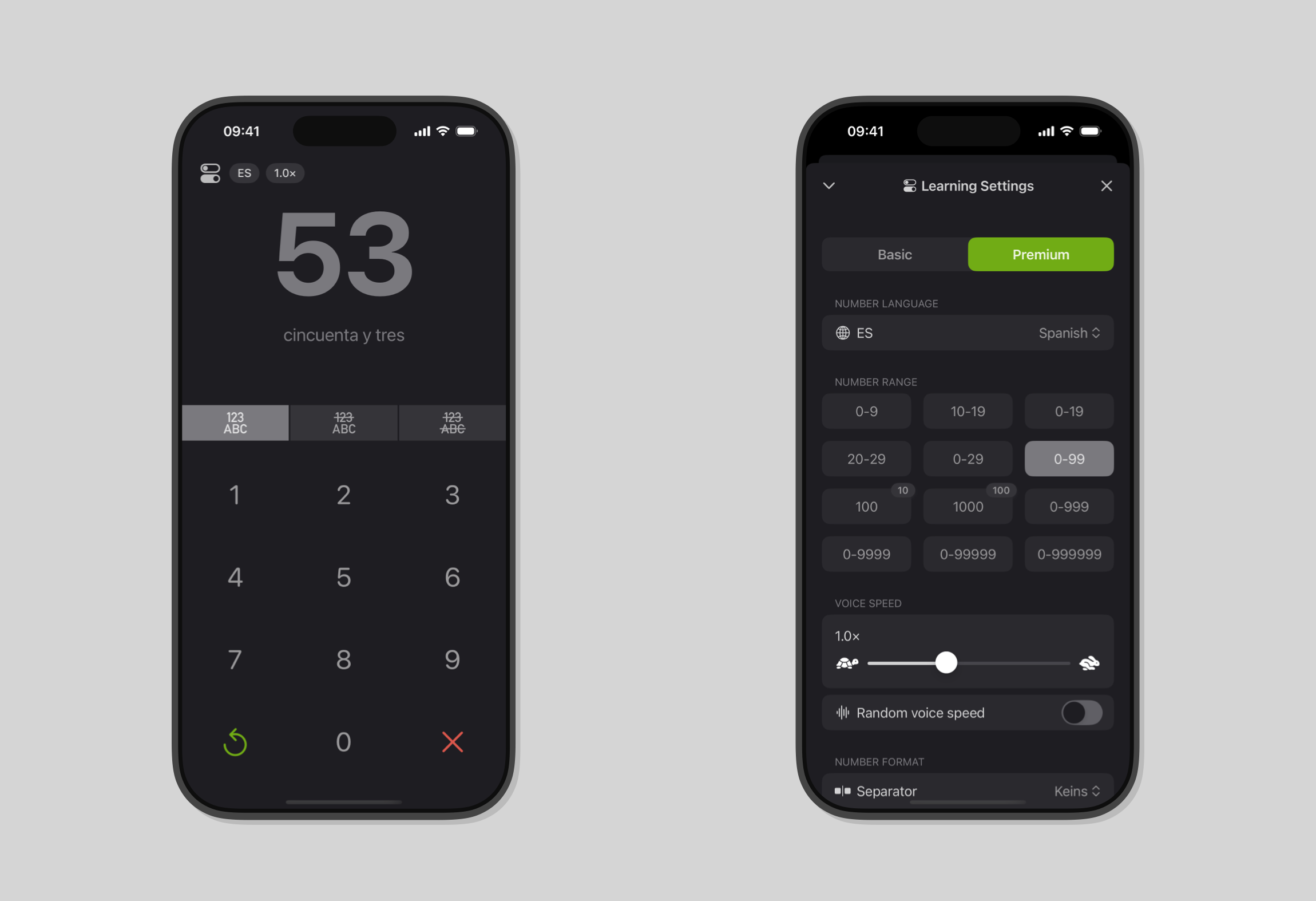
That's exactly why Numfred exists. It's an app that does exactly one thing: read numbers to you, and you enter them. Sounds simple, and it is. But that's exactly the point. You open the app and off you go. No preparation, no searching for suitable material.
With Numfred you train:
No registration, no subscription! Numfred Basic offers free basic number ranges in 13 languages. For more features, there's Numfred Premium.

More articles & tips about learning numbers in foreign languages can be found in our Blog.
Numbers are everywhere. Shopping, on the phone, at work, while traveling. If you don't understand them, you feel insecure—even if you actually speak the language well. The good news: Numbers can be trained, and pretty quickly at that.
Just start. A few minutes a day are enough and you'll quickly notice what a huge difference it makes in everyday life.
