
Numfred Blog
Have you ever wondered why some buildings in Japan skip the 4th floor? Or why big numbers seem to work differently than what you're used to? The Japanese number system has a few fascinating quirks – from multiple readings for the same number to a completely different way of grouping large amounts.
In this article, you'll learn how Japanese numbers are built, where learners usually get tripped up, and how to internalize them quickly with the right kind of practice.
Japanese numbers are written with Chinese characters (kanji) and come with a twist that surprises many beginners: Many numbers have two different readings. The Sino-Japanese reading (On'yomi) comes from Chinese, while the native Japanese reading (Kun'yomi) is originally Japanese.
For everyday counting, the Sino-Japanese variant is used most of the time – and it's pleasantly logical.
These ten numbers are your foundation. They are written in kanji. In parentheses, you'll find the most common reading for plain counting:
Important: 4, 7, and 9 have alternative readings. Because "shi" (4) sounds like the word for "death" and "ku" (9) can be associated with "suffering", many people prefer yon, nana, and kyū when counting. But watch out: In fixed words and especially in times, the other readings often come back.
From 11 onward, the logic really shines. Unlike English, which has its own irregularities, Japanese builds numbers consistently:
Once you get this pattern, you can form any number up to 99 on the spot.
This is where it gets really interesting – and a little mind-bending at first. In English, we group large numbers in thousands (thousand → million → billion). Japanese groups large numbers in ten-thousands.
The key unit is 万 (man), which means 10,000:
This takes a mental shift: When someone says "jūman", you shouldn't hear "ten" – you should hear 100,000.
For even larger numbers, Japanese uses 億 (oku) for 100 million. One billion is therefore 十億 (jūoku) – "ten times one hundred million".
Japanese numbers are logical, but these points often cause confusion:
If you travel to Japan or study Japanese, you'll run into numbers everywhere:
For more details and all numbers from 1 to 100, see our full guide to Japanese numbers.
Hearing and understanding numbers is one thing – using them confidently in real life is another. Numfred is an iPhone learning app that lets you specifically practice Japanese numbers.
What makes it special: You can switch the grouping of numbers from thousands to myriads. That way, 10,000 is displayed as "1.0000" – which makes it much easier to internalize the Japanese "man system" (steps of 10,000).
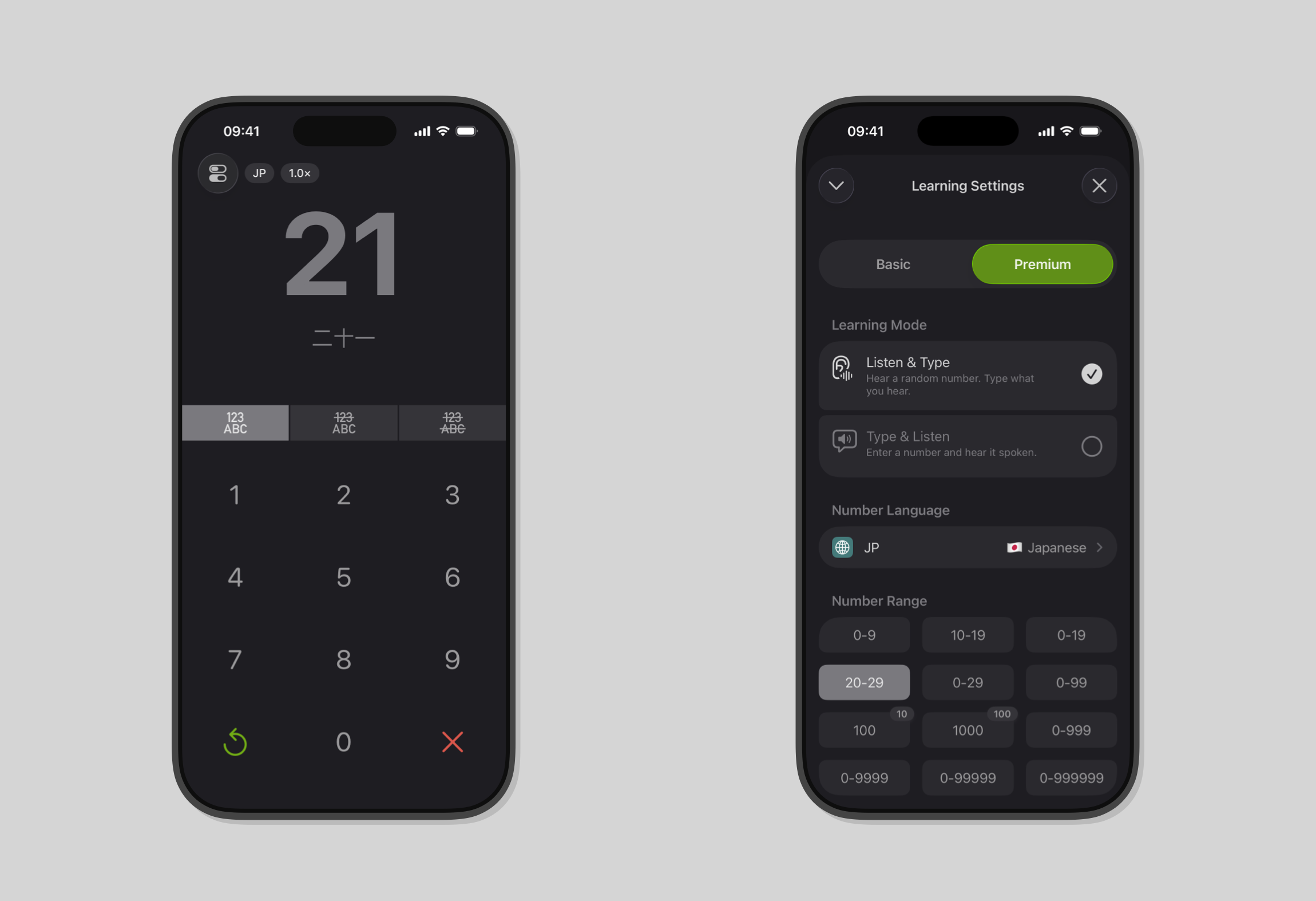
The app offers authentic voice recordings, multiple difficulty levels, and works completely offline – perfect for your next trip to Japan.

For more tips, visit our blog or read our article on Chinese numbers.
The Japanese number system is surprisingly systematic once you understand the core idea. The biggest hurdle is switching to ten-thousands and getting comfortable with the sound changes.
With regular listening practice and an understanding of the cultural quirks (lucky numbers, counters), you'll soon be able to handle Japanese numbers confidently – whether you're shopping in Tokyo, reading manga, or taking your next Japanese class.
