Numfred Blog
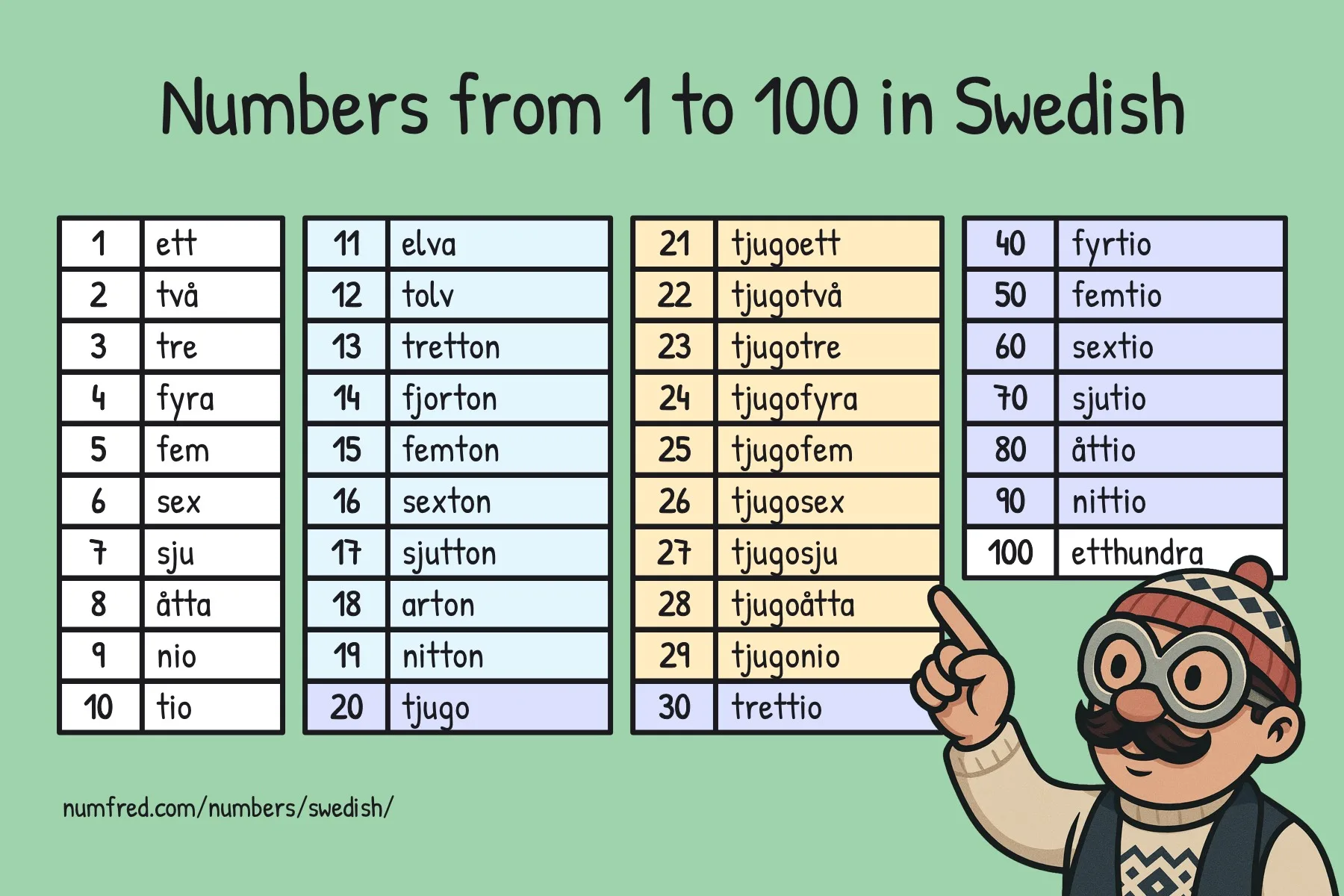
Here is a quick overview of Swedish numbers from 1 to 100. The chart is useful when you want to look up the most important numbers, review them, or get a first sense of how the system works.
Swedish numbers are fairly intuitive for English speakers. In compound numbers, Swedish puts the tens first and the ones second, just like English:
Many Swedish numbers are also written as one word. That makes the structure clear when you read them, but it can feel unfamiliar when you hear them spoken quickly. For example, sjuttio and tre become sjuttiotre.
The numbers from 1 to 12 have their own forms: ett, två, tre, fyra, fem, sex, sju, åtta, nio, tio, elva, tolv.
From 13 to 19, you will often see the ending -ton: tretton, fjorton, femton, sexton, sjutton, arton, nitton.
From 20 onward, Swedish is very regular: tens plus ones, usually written together as one word. Examples are tjugoett (21), fyrtiotvå (42), and åttioåtta (88).
The number 100 is hundra. For "one hundred", both hundra and etthundra are possible in Swedish.
If you want the full explanation, check out our guide to Swedish numbers with rules, examples, and tips for daily life, travel, and listening comprehension.
With this short test, you can practice recognizing written Swedish numbers. It is a good first step for understanding the structure and seeing where you still feel unsure.
The next step is listening comprehension. That is where Numfred comes in: In the app, you hear Swedish numbers and type what you understood. This helps you train for situations where numbers really matter: at a train station, in a store, in a conversation, or on the phone. Download Numfred for iPhone on the App Store.