Numfred Blog
"Twenty-four" or "four-and-twenty"? For English speakers, the former sounds completely natural – but in German and Dutch, they flip it around. Imagine: You're in an international conference call with a German colleague who quickly says "vierundsechzig" (64). Your brain hears "vier" (four) first and has to hold that in mental limbo until "sechzig" (sixty) finally arrives. It takes just milliseconds longer, but it's surprisingly exhausting.
These seemingly small differences make numbers in foreign languages one of the most underestimated challenges in language learning. While we're memorizing vocabulary and cramming grammar rules, we often overlook: Numbers follow their own patterns in each language, sometimes ancient ones – and they can be extremely different.
It's fascinating how differently people count around the world. Why does French require math after 70? Why do Chinese, Japanese, and Korean speakers think in blocks of ten-thousands instead of thousands? And why do Germans (and the Dutch) flip their numbers backward?
In this article, I'll take you on a journey through the world's number systems. You'll learn not just what makes languages different, but also why – and most importantly: how to use these differences to your advantage to confidently understand numbers in any language.
At first glance, it seems simple: Almost all languages use the decimal system with ten digits (0–9). So far, so familiar. But then comes the question that changes everything: In what order are the ones and tens digits stated?
Here the language world splits into two fundamental camps – and this has direct consequences for your listening comprehension:
German and Dutch take a special path. They say "vierunddreißig" (four-and-thirty) – the four comes first, then the thirty. For native speakers, it feels natural.
But to everyone else, it sounds backward. And here's the challenge: If you're an English speaker learning German or Dutch, you have to mentally switch gears. Your brain expects the tens digit first, but it comes last – that's more taxing than you'd think.
The overwhelming majority of world languages do it the other way around: English, Spanish, Italian, Portuguese, Russian, Turkish, Swedish, Chinese, Japanese, Korean – they all state the tens digit first, then the ones.
"Thirty-four", "treinta y cuatro", "trentaquattro" – the structure is always the same. For people who grew up with this logic, the German word order sounds absurd.
And then there's French, which has its own unique philosophy: After 70, you don't just count – you calculate. More on that in a moment.
These fundamental differences explain why numbers in foreign languages are such a challenge. It's not just about memorizing vocabulary – it's about rethinking.
"Achtundsechzig" (eight-and-sixty) – for German speakers, this sounds perfectly logical. But did you know this makes them part of a tiny minority? This ones-before-tens logic is essentially shared only with the Dutch.
The reversed number order has historical roots. In Middle High German and Old Low German, this structure was common – a relic that has persisted to this day, while most other languages put the tens first.
If you're an English speaker learning German, you have to mentally switch. Your brain is trained to expect the tens first. With "achtundsechzig" you hear "acht" (eight) first – and you have to hold a placeholder in your head until "sechzig" (sixty) arrives. That takes milliseconds longer and requires more concentration.
Conversely, non-German speakers learning German have the exact same problem: They hear "acht-und..." and briefly think "eight what?" before "sechzig" comes.
The Dutch count by the same principle: tweeënveertig (42), drieëntwintig (23). The small but important difference: the diaeresis (¨).
Important: The diaeresis is not an umlaut! It's a separation mark that signals: "These two vowels are pronounced separately, not as a diphthong." In "tweeën", the second "e" is pronounced separately – otherwise it would sound like a long "ee".
These details make the difference between "sounds okay" and "sounds like a native speaker".
More details: 🇩🇪 German Numbers and 🇳🇱 Dutch Numbers.
While Germans flip their numbers around, Romance languages and English follow a clear, predictable structure: Tens before ones. But each language has its own little nuances – and those make the difference in listening comprehension.
Spanish has a charming peculiarity: The twenties are written as one word. Veintiuno (21), veintidós (22), veintitrés (23) – the numbers merge into a single word. And watch those accents! They're not just decoration; they change the stress and thus the sound.
From 30 onward, it gets simpler and follows a consistent pattern: treinta y cuatro (34), cincuenta y seis (56). The y ("and") connects tens and ones, and everything is written separately.
Practical Tip: At Spanish markets or restaurants, numbers are often rattled off incredibly fast. When you hear "veintidós", it sounds almost like a single short word when spoken quickly. Your ear needs training to parse it!
Italian loves melody – even with numbers. That's why numbers are pronounced to sound fluid. This leads to interesting vowel mergers:
From 30 onward, the structure remains stable: trentaquattro (34), cinquantasei (56). Everything's one word, no hyphens, no "e" in between.
Listening Tip: In spoken Italian, these numbers flow like music. If you don't train them, they'll get lost in the flow of speech.
Portuguese is structurally similar to Spanish – with one crucial detail: Instead of "y", an e connects tens and ones.
But here's the peculiarity: In large numbers with gaps, the "e" reappears to mark the jump:
The "e" signals: "Attention, something's missing between thousands and ones!"
Regional Note: European Portuguese and Brazilian Portuguese differ significantly in pronunciation. The numbers stay the same, but the sound varies – which can surprise you when listening.
English seems simplest at first glance: twenty-seven (27), thirty-four (34), ninety-nine (99). Tens, hyphen, ones. Done.
But the catch lies in similar-sounding numbers:
In fast conversations, poor phone connections, or with accents, this difference blurs – and suddenly 50,000 becomes 15,000.
Pro Tip: Native speakers often repeat numbers in important contexts (business, medicine) or say "one-five" instead of "fifteen" to avoid misunderstandings.
Want more depth? 🇪🇸 Spanish Numbers, 🇮🇹 Italian Numbers, 🇵🇹 Portuguese Numbers, 🇬🇧 English Numbers.
French is considered by many to be the most beautiful language in the world – elegant, melodic, romantic. But when it comes to numbers, things get mathematical fast. Because after 70, simple counting stops, and calculating begins.
The answer lies in history: French has preserved remnants of a vigesimal system (base-20). While other languages switched completely to the decimal system, French partially stuck with the old system.
The result is fascinating – and initially confusing for learners:
Then comes 80, and here it gets really interesting:
Yes, you read that right: 99 is four times twenty plus ten plus nine. Your brain has to calculate lightning-fast when listening!
Here's a subtlety that trips up even advanced learners: quatre-vingts (80) gets an -s because it's a multiple of twenty – like "quatre cents" (400).
But: As soon as another number follows, the -s disappears:
This rule also applies to "cent" (hundred): "deux cents" (200), but "deux cent cinquante" (250).
By the way: In Switzerland, people frequently use septante (70), huitante (regionally also octante), and nonante (90). In Belgium, septante (70) and nonante (90) are common; 80 usually remains quatre-vingts. For learners, this is much easier – but if you're learning French for France, you can't escape the math.
Imagine: Someone quickly says "quatre-vingt-quinze" (95). Your brain must: 1. Recognize "quatre-vingt" (= 80) 2. Recognize "quinze" (= 15) 3. Add them together (80+15 = 95) 4. And all of this in fractions of a second!
In shops when hearing prices or numbers in conversations, this can become a real challenge. That's why targeted listening training is so important for French numbers.
All details: 🇫🇷 French Numbers.
These three languages couldn't be more different – geographically, culturally, linguistically. Yet with numbers, there are interesting parallels and remarkable differences.
Swedish loves compound words – and this shows in numbers too. Everything is written together, without hyphens, without "and":
This looks simple at first glance. The challenge lies elsewhere: When you hear Swedish, you have to quickly break down the long word into its components. "Sjuttiotre" isn't one word, but "sjuttio" (70) + "tre" (3).
Listening Tip: Swedish has very melodic intonation with tonal accents. Some words sound completely different depending on stress. With numbers this is less problematic, but the speed can be challenging.
Peculiarity: Swedish uses (like English) the logical order tens-before-ones – completely different from related German!
Russian numbers also follow the tens-before-ones principle: тридцать четыре (34) = "tridtsat' chetyre" – literally "thirty four".
But here lurks a nasty trap: similar-sounding number pairs that are easily confused when listening:
The difference? A few syllables! But in fast conversations, the sounds blur, and suddenly you've understood 60 instead of 16.
Similarly confusing:
Additional Challenge: Russian numbers decline! Depending on the case (nominative, genitive, dative...), the form changes. "Two books" is different from "with two books". For beginners, this is initially overwhelming.
Practical Tip: If you're learning Russian, train these number pairs specifically. They come up constantly – from prices to times – and confusion is costly.
Turkish is one of the few languages where learners can breathe easy: The number system is gloriously simple and consistent!
Tens and ones are written and spoken separately. No mergers, no exceptions, no calculations.
Why Is Turkish So Beautifully Simple?
Turkish is an agglutinative language with clear, regular rules. There are hardly any irregular verbs or exceptions – and that applies to numbers too. What you see is what you hear.
Only Catch: Turkish pronunciation has a few sounds that are unfamiliar to English speakers (like the soft "ğ" or the dark "ı"). But the number structure itself? Child's play.
More details: 🇸🇪 Swedish Numbers, 🇷🇺 Russian Numbers, 🇹🇷 Turkish Numbers.
Now we come to one of the most fascinating differences in the world of numbers: the East Asian number system. Chinese, Japanese, and Korean work fundamentally differently from Western languages – and this has far-reaching consequences.
In English, we think in thousands:
We group numbers in blocks of three: 1,234,567 is read as "1 million, 234 thousand, 567".
East Asia thinks in blocks of 10,000:
All three languages – Chinese, Japanese, and Korean – use 10,000 (万/萬) as their base unit.
This means: Large numbers are grouped in blocks of four, not three!
We think: 120 × 1,000
Literally: "twelve ten-thousands" = 12 × 10,000
Same structure: 12 × 10,000
Also: 12 × 10,000
This sounds like a minor detail, but in practice it's a massive mental shift!
Imagine you're reading a Chinese newspaper and see: 三百五十万 (sān bǎi wǔ shí wàn).
Your brain must calculate:
For us "three point five million" – for a Chinese speaker simply "350 wàn".
It gets even more extreme with the next larger unit in Japanese, 億 (100 million):
Literally: "3 億 + 5 千万" = (3 × 100,000,000) + (5 × 10,000,000 = 5000 × 10,000 = 50,000,000)
What for us is "350 million" has a completely different mental structure in Japanese.
The answer lies in history and writing. The Chinese number system is thousands of years old and based on different mathematical thinking. It's not better or worse than ours – just different.
Interestingly, studies show that children in East Asia often develop good number sense earlier. This is because the number structure is extremely logical and without exceptions: 11 is literally "ten-one", 21 is "two-ten-one" – no special forms like "eleven" or "twelve".
If you're learning Chinese, Japanese, or Korean, you must mentally switch. This means:
This takes practice – but once it "clicks", a new way of thinking opens up. And you'll understand why Asians sometimes briefly pause when they need to say large numbers in English: They're just converting from 万 to "thousands"!
All details: 🇨🇳 Chinese Numbers, 🇯🇵 Japanese Numbers, 🇰🇷 Korean Numbers.
Now you know the world's major number systems and their peculiarities. But how do you get your brain to not just understand these differences, but process them automatically?
Numbers aren't arbitrarily twisted. Behind every system lies history, culture, and logic. When you understand why French calculates after 70 or why Chinese thinks in ten-thousands, you'll remember the structures much better.
This "why" makes the difference between "I'm memorizing vocabulary" and "I understand the language".
Reading is one thing – listening is quite another. When someone quickly says "quatre-vingt-quinze", you have no time to think. Your brain must process lightning-fast: That's 80+15 = 95.
This only works through targeted listening training. Not through textbooks, but through repetition, practice, and immediate feedback.
Numbers are everywhere: prices, times, house numbers, phone numbers, temperatures. Use that! When you pass a store, translate the prices in your head into your target language. When you see the time, say it out loud in Spanish or Japanese.
These small moments add up – and train your brain to think in the new number structure.
Precisely for this challenge, there's Numfred: An app that specializes exclusively in listening comprehension for numbers.
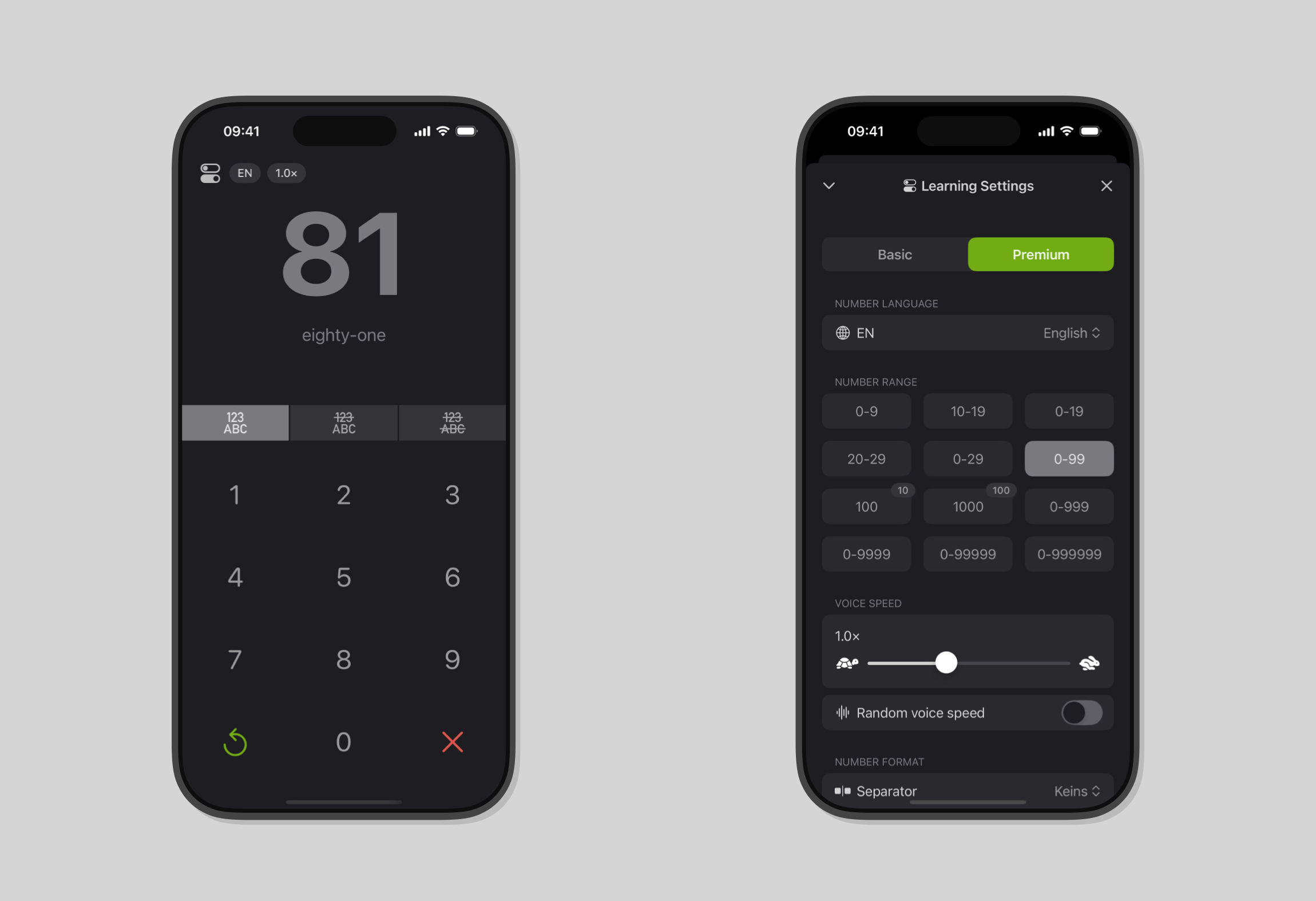
With Numfred you train:
Just 5 minutes daily is enough to dramatically improve your number comprehension. Start right away – no registration required. Test basic number ranges in all 13 languages.

Numbers reveal a lot about a language's culture and history. They show how people think, calculate, and structure the world.
When you understand the world's number systems, a new perspective opens up. You recognize patterns that were hidden before. You understand why certain things are the way they are. And most importantly: You become more confident dealing with numbers in any language.
German with its reversed ones-tens order may be unusual – but it's part of its linguistic identity. French may seem confusing with its calculation operations – but it carries the history of an ancient base-20 system. And East Asian ten-thousand thinking may initially seem foreign – but it opens a window into a completely different mathematical mindset.
